Student Achievement
Rice University is an institution steeped in tradition and committed to unparalleled excellence.
We are working to become the premier university in the world for teaching and research, with an ambitious vision to preserve what we cherish as unique to our institution while innovating to meet the future needs of our students and the world.
Rice University uses multiple criteria to document student success and assesses its effectiveness with respect to student achievement by monitoring trends in:
- Overall undergraduate 6-year (150%) graduation rate (Student completion indicator)
- First-time, first-year undergraduate student retention
- Undergraduate first-destination after graduation
- Doctoral time to degree.
Achievement goals and outcomes data for each criterion are detailed below.
Goals are presented for each metric along with a rationale for selection of the metric and goal.
Criterion One: Six-year Graduation Rates
The six-year IPEDS graduation rate is Rice’s selected Student Completion Indicator on file with SACSCOC. The six-year IPEDS graduation rate was selected as Rice’s Student Completion Indicator because it is an important metric that the university regularly evaluates as part of its goal to provide an outstanding undergraduate education and for continuous improvement purposes.
The threshold of acceptability for the IPEDS six-year graduation rate measure (and for each disaggregated group) is for the rate to be at or above 86% which is the average six-year graduation rate for all Association of American Universities (AAU) institutions in academic year 2020. Currently, AAU comprises 71 leading research institutions including Rice and therefore provides appropriate comparators. The goal for the IPEDS six-year graduation rate measure (and for each disaggregated group) is 94% which is the academic year 2020 average six-year graduation rate for Rice’s highly reputed AAU peer group. The use of the AAU peer groups is a standard practice at Rice and is thus appropriate for use in the assessment of student achievement. The use of all AAU institutions and Rice’s highly reputed peer group creates a consistent use of a peer group and examines the overall achievement in comparison to achievement of Rice’s peer group. These groups provide a more useful and meaningful peer comparison for Rice than other available metrics, given the composition of the institutions. The institution’s data is based on IPEDS reported data and methodology. Table 1 demonstrates Rice’s high achievement on the six-year graduation rate student completion indicator over the past five years.
Table 1: IPEDS Six-year (150%) Graduation Rates (SACSCOC Institution Selected Metric)
| Graduation Rates | |||||
|---|---|---|---|---|---|
| Entering Cohort | Fall 2014 (AY 2021) | Fall 2015 (AY 2022) | Fall 2016 (AY 2023) | Fall 2017 (AY 2024) | Fall 2018 (AY 2025) |
| 6-year (150%) Graduation Rate | 94.2% | 92.3% | 93.6% | 95.7% | 94.6% |
Source: Rice University Office of the Registrar and the Office of the Dean of Undergraduates; Prepared by Rice University Institutional Research & Analytics, January 2025
Results Analysis: Six-year Graduation Rate
As shown in Table 1, Rice consistently exceeds the threshold acceptability of 86% for overall six-year undergraduate graduation rates. Rice’s success in achieving high graduation rates may be attributed to Rice’s many layers of support for student achievement, as well as the general culture of care present across the University.
Criterion Two: Undergraduate Retention
An important criterion for Rice is the retention rate for first-time, first-year (FTFY) undergraduate students. Undergraduate retention rate was selected as a student achievement metric because it supports the institutional goal and priority of providing an excellent undergraduate education and because of the emphasis on Rice’s culture of care, which is intended to promote an outstanding campus experience. The threshold of acceptability for retention rates at Rice for FTFY undergraduate students is expected to meet or exceed the AAU institutions’ average retention rate for FTFY undergraduate students in Fall 2019 (AY 2020), which was 94%. The goal for retention rates at Rice for FTFY undergraduate students is set at 97% using the typical average retention rate for Rice’s target peer group of AAU highly reputed peer institutions. Typically the five year average for highly reputed AAU peer institutions is above 97% (the lower average in fall 2020 is due to COVID-19). AAU institution overall averages and Rice’s highly reputed AAU institutional peers are used as general practice at Rice and are also consistent with assessment methods in examining six-year graduation rates. Full-time is defined as a student enrolled in at least twelve semester credit hours. Retention rate data is IPEDS reported data and is adjusted for allowable exclusions, which include the death of a student, permanent disability, military deployment, or service on an official church mission or with a foreign aid service of the Federal government. Table 2 demonstrates Rice’s success in achieving high FTFY undergraduate retention over the past five years.
Table 2: First-time First-year Undergraduate Retention Rates
| Cohort Year | Fall 2019 (AY 2020) | Fall 2020 (AY 2021) | Fall 2021 (AY 2022) | Fall 2022 (AY 2023) | Fall 2023 (AY 2024) |
|---|---|---|---|---|---|
| FTFY Undergraduate Retention Rate | 96.7% | 97.1% | 98.1% | 97.6% | 97.4% |
Source: Rice University Office of the Registrar and the Office of the Dean of Undergraduates; Prepared by Rice University Institutional Research & Analytics, February 2025
Results Analysis: Undergraduate Retention
Using the Fall 2019 AAU institutions’ average retention rate of 94% as the threshold for acceptability, Rice outperformed the threshold of acceptability in each of the reported years as shown in Table 2. Rice’s exceptional support for undergraduates academically and personally accounts for the high retention rate.
Criterion Three: Undergraduate First-destination Outcomes
Rice selected undergraduate first-destination outcomes as the third metric for measuring student achievement because as a highly ranked national research institution, understanding where our undergraduates go in their first year after completing their first undergraduate degree is important to continued excellence. First-destination outcomes data also helps Rice assess how it performs against national averages on this metric, which helps improve Rice’s competitiveness. Rice University’s Center for Career Development (CCD) monitors the first destination of undergraduates after graduation. To collect the data, CCD follows the National Association of Colleges and Employers (NACE) First-Destination Survey standards and protocols. Rice is one of more than 300 institutions nationally that follows this protocol and contributes data to NACE’s national survey. The data is sourced through the annual First Destination Survey (administered by the Center for Career Development using the 12twenty tool), phone and email communication to non-respondents, and LinkedIn. The first-destination data presented includes bachelor’s-level graduates who graduated between July 1 and June 30 of the graduating class year. An 88% graduating senior first destination knowledge rate for years included in this analysis was achieved. The knowledge rate only dropped slightly as a result of the COVID-19 pandemic but returned to a minimum 95% for the three most recent years included in this analysis. In viewing the data, “service” is volunteer service, officially defined by NACE as graduates who are participating in a volunteer or service program (e.g., Peace Corps, mission work). Military is omitted from the data due to no respondents reporting military service.
The goal and threshold of acceptability for undergraduate first-destination outcomes in the first six months following graduation is that at least 82% of undergraduates are employed or pursuing continuing education. For the purpose of this analysis, students engaged in service are counted as employed. The threshold is set using the NACE annual report’s national career success outcomes average in 2020, which was 82%. The goal and threshold are the same because they align with the national NACE average. Rice’s first-destination outcomes data for 2020-2024 is presented in Table 3.
Table 3: Undergraduate First-destination Outcomes, 2020-2024*
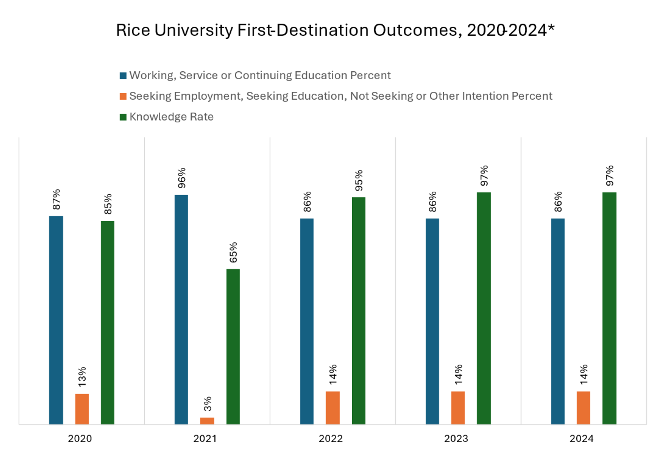
*Percentages may not equal 100% due to rounding error
Results Analysis: Undergraduate First-destination Outcomes
As shown in Table 3, for all years included in this analysis the threshold of acceptability was exceeded with a minimum of 86% of students achieving the desired outcome within six months following graduation (years 2022, 2023, and 2024), 96% of students achieving the desired outcome in 2021, and 87% of students achieving the desired outcome in 2020. In 2021, Rice had a much lower knowledge rate than usual, at only about 65%. The lower knowledge rate in 2021 may be due to fewer students at the time knowing their next steps with certainty, which can make them hesitant to report any information. Additionally, CCD experienced staffing changes in 2021 that limited their resources and ability to follow up with graduate non-respondents and conduct LinkedIn research as CCD did in other years to obtain a higher knowledge rate. The outcome in 2021 may be related to the lower knowledge rate that year. Overall, Rice is pleased with the first-destination outcomes of its undergraduate students and attributes this achievement to the many horizontal and vertical student achievement supports available at Rice.
Criterion Four: Doctoral Time to Degree
Educational excellence, research and innovation are at the heart of Rice University’s mission statement and strategic plan. Doctoral time to degree is a key metric for Rice. As a highly ranked national research institution, ensuring that doctoral students complete degrees in a timely manner helps Rice to be competitive among peers and helps ensure it contributes meaningfully to research and innovation in the U.S. and globally. At Rice, doctoral degrees are offered in six academic schools and interdisciplinary doctoral programs are offered for Applied Physics students (as per the description appearing below Table 4). Analysis of doctoral time to degree includes all doctoral programs at Rice. It is important to note that time to degree for doctoral programs varies by discipline and for some areas such as in the humanities, nationally, doctoral degrees can take 18 to 24 months longer on average compared to doctorates in science and engineering fields. The threshold of acceptability and goal set for doctoral time to completion at Rice is the same to account for variability across disciplines, at 7.3 years doctoral time to degree, and is based on the 2018 reported median number of years to complete the research doctorate after starting graduate school per the National Science Foundation, Survey of Earned Doctorates (SEDs) which is used by many institutions to set their thresholds of acceptability because it is a publicly available data set. Rice University’s median doctoral degree completion rates for the past five years are presented in Table 4:
Table 4: Rice University, Doctoral Time to Degree, Graduation Years 2020-2024
| School | Academic Year of Graduation | ||||
|---|---|---|---|---|---|
| 2020 | 2021 | 2022 | 2023 | 2024 | |
| Interdisciplinary* | 5.78 | 6.03 | 5.04 | 5.36 | 5.2 |
| Jones School of Business | 5.78 | 5.74 | 5.71 | 5.71 | 5.71 |
| School of Engineering | 5.36 | 5.55 | 5.03 | 5.36 | 5.03 |
| School of Humanities | 7.03 | 7.03 | 6.36 | 6.71 | 7.03 |
| School of Music | 5.36 | 3.73 | 3.71 | 6.71 | 5.71 |
| School of Natural Sciences | 5.78 | 5.74 | 5.36 | 5.36 | 5.36 |
| School of Social Sciences | 5.78 | 5.74 | 5.71 | 5.71 | 5.71 |
| Total | 5.78 | 5.74 | 5.36 | 5.36 | 5.36 |
*”Interdisciplinary” refers to applied physics students because they matriculate in natural sciences but then may specialize in an area of applied physics that resides in engineering. We place them in the “Interdisciplinary” school category because they may “major” in either school. Applied physics is not considered a dual degree program.
Prepared by: Rice University Institutional Research and Analytics November 2024
Results Analysis: Doctoral Time to Degree
Doctoral time to degree rates at Rice are consistently below the 7.3-year national median target threshold of acceptability, which is a positive outcome. The data reveal differences in the slightly longer time to degree for humanities students, which is typical nationally, and variation across the various disciplines which is expected. The shorter time to degree for music students may be related to the different nature of those doctoral programs. The high student achievement for doctoral time to degree may also be attributed to Rice’s culture of care and excellent support for students throughout their studies at Rice, where they receive peer and faculty mentoring, support from the Dean of Graduate and Postdoctoral Studies office, research librarians and staff in the respective schools and also at Fondren Library.